






The Quiet Exit Problem in AEC


Why strong performers disengage long before they resign, and what leaders can do about it.
Dan had been with the firm for six years. He knew the clients by name. Not just the project managers, but the site superintendents and the admin assistants who scheduled the walkthroughs. He had led three major projects from schematic design through closeout, on time, cultivating the kind of client relationships that take years of trust to earn.
He wasn’t unhappy. Nothing was technically wrong.
But somewhere around year four, the conversations about his future had quietly stopped. His reviews came and went. When he asked about taking on a larger client-facing role, the answer was noncommittal, supportive in tone, but vague in substance. There was no breaking point. Just a slow, accumulating sense that the firm wasn’t structured to support where he wanted to go. That might have been fixable, but no one above him seemed to notice the gap, let alone lose sleep over it.
So he started taking calls. When a competing firm made him an offer, it wasn’t just about compensation. They talked about leadership opportunities, mentorship and a clear path forward – backed by benefits and flexibility that reflected that same investment. Things like leave policies and real flexibility in how and where he worked reinforced the message: he wasn’t just there to produce, he was there to grow.
Dan is a composite. But his story isn’t. Across AEC, versions of it play out quietly every week.
What the Numbers Say
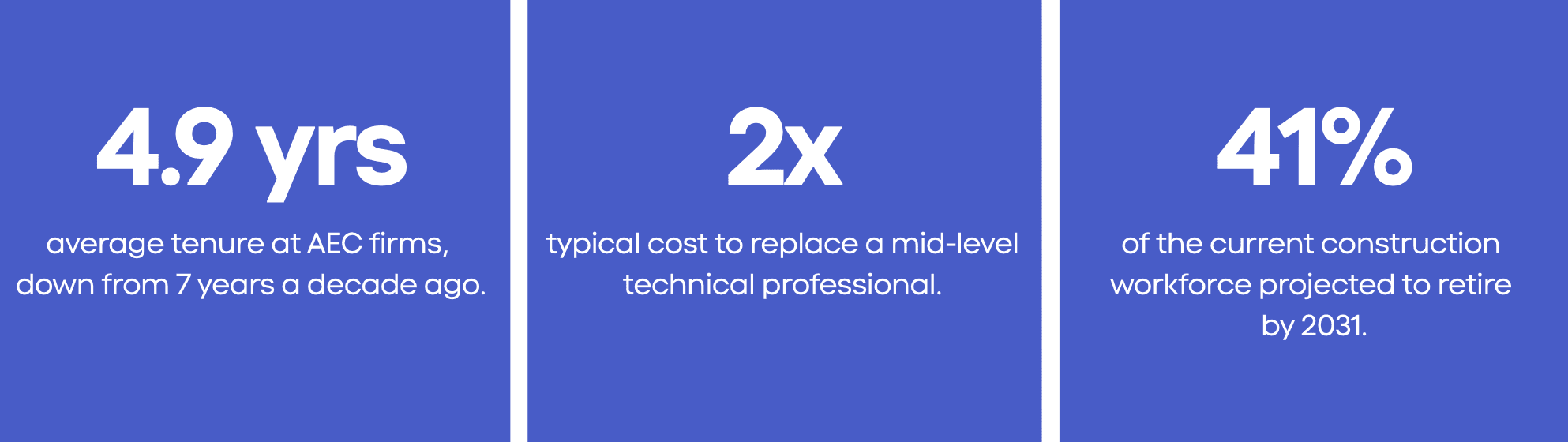
*see full references below
These aren’t abstract statistics. They show up in delayed submittals, stretched project managers and client relationships that erode when the familiar face on the other end of the phone disappears.
But here’s what the data misses: most departures aren’t driven by compensation alone. They’re driven by something harder to measure and harder to fix with a counteroffer.
A Conversation with Kelly Riggs
The data tells you there’s a problem, but it doesn’t tell you why. It’s something we’ve been working to better understand within our own teams. For that, we turned to Kelly Riggs, a leadership coach, author of Counter Mentor Leadership and a trusted advisor to our Wallace team for nearly 20 years. We asked him what’s really driving people out the door and what leaders can do about it.
Strong performers don’t leave because something is wrong. They leave because something is missing.
“Almost always, they don’t feel valued,” Riggs says. “And firms often mistake increased responsibility for recognition. Giving strong performers more responsibility may signal trust, but if the rewards, growth or opportunities don’t follow, people eventually feel taken advantage of instead of developed.” Over time, people start asking a simple question: What is all this effort leading toward? It’s a question leaders can’t afford to leave unanswered for long. That feeling compounds when the firm’s structures don’t reflect the same investment – when benefits haven’t kept pace with where people are in their lives, or when policies make flexibility feel like an exception rather than the norm.
The expectations around work are shifting – faster than most firms are adapting.
“The generation coming up isn’t asking to cut corners,” Riggs explains. “They’re asking for space to do excellent work their own way.” When the default response is “that’s not how we do it,” the message is clear, even if it’s unintentional. Over time, that lack of flexibility affects morale in quiet ways – the kind that don’t show up immediately, but change how much people choose to engage. The leaders keeping their people are the ones willing to ask: does it need to be done this way, or does it just need to get done well?
Leaders often misdiagnose why people leave.
“Exit interviews are largely fiction,” Riggs says. “People say it was the money, and sometimes that’s true. Compensation matters, and so does quality of life, but more often, it was a manager who was never really present. Motivation isn’t complicated: people want to feel their work matters, and that they matter to the people and the company they work for. When those two things are in place, a lot of other factors become negotiable.”
“Disengagement doesn’t announce itself. It shows up as withdrawal. The person who used to push back in meetings stops speaking up. By the time the resignation letter lands, the decision was made months ago.”
— Kelly Riggs
The fix isn’t complicated. But it’s not easy.
“Be present. Not in theory, but actually present,” Riggs says. “Put down the project drawings and have a real conversation. The soft skills this industry tends to avoid – empathy, self-awareness, genuine listening – aren’t soft. They’re the hardest things most leaders are asked to do. If you’ve been unavailable to your team and you know it, say so. Ask: “Is there anything I’ve failed you on?” That kind of humility is rare. And people can tell the difference between a leader who genuinely cares and one who’s managing a retention risk.
Three things any leader can do this month that we continue to reinforce within our own teams
01 Start a one-on-one with no agenda. Pick one person and schedule thirty minutes with no project milestones to review. Ask how they’re doing and actually listen. This is the foundation that makes every other conversation possible.
02 Name what you see, specifically. Not “great job on that project,” but “the way you handled that RFI turnaround under pressure showed real judgment.” Specificity signals that you’re paying attention. That signal matters more than you think.
03 Ask the uncomfortable question. The next time you’re with a key team member, try: “Is there anything I could be doing better for you?” It takes ten seconds of courage. The act of asking changes the relationship regardless of what they say. And don’t stop at your own leadership, ask what the firm itself could be doing or offering differently. The answers will surprise you.
Retention isn’t a hiring problem. It’s a leadership problem – and a reflection of the systems around it. It starts long before anyone updates their resume. The leaders who stay present matter. So do the firms willing to build structures that back them up.
Kelly Riggs has spent his career helping leaders close the gap between who they intend to be and who their people actually experience. If his perspective resonated, explore his work at kellyriggs.com – and pick up Counter Mentor Leadership if the multigenerational piece hit close to home.
References
- Stambaugh Ness. (2024, November 20). AEC 2025 forecast: Navigating workforce and market changes. https://www.stambaughness.com/blog/aec-2025-forecast-navigating-workforce-market-changes/
- SHRM. (n.d.). The myth of replaceability: Preparing for the loss of key employees. https://www.shrm.org/executive-network/insights/myth-replaceability-preparing-for-loss-key-employees
- National Society of Professional Engineers. (2025, February 23). 2025 engineering survey: A critical workforce challenge [Social media post]. LinkedIn. https://www.linkedin.com/posts/national-society-of-professional-engineers_our-2025-engineering-outlook-survey-highlights-activit

40 Acts of Service: Making Lives Better Through Community Involvement

Seller/Doer Mentality: A Blueprint For Engineering Success

Engineer-Contractor Relations Part I: Enhancing Your Engineering Career Through Quality Contractor Connections
Leveraging a Unified Marketing Strategy for Business Growth

Giving Tuesday – Reaching Beyond Our Borders