


How the 2024 IBC Changes Tornado Design for Healthcare Facilities
A State-by-State Guide for Healthcare Owners, Developers and Their Design Teams
Healthcare facilities are expected to remain operational during society’s most disruptive events – from pandemics to natural disasters. Yet until recently, the model building codes governing hospital construction contained no explicit structural design requirements addressing tornado hazards, despite the growing financial and human impact of severe convective storms across much of the United States.1
That is changing.
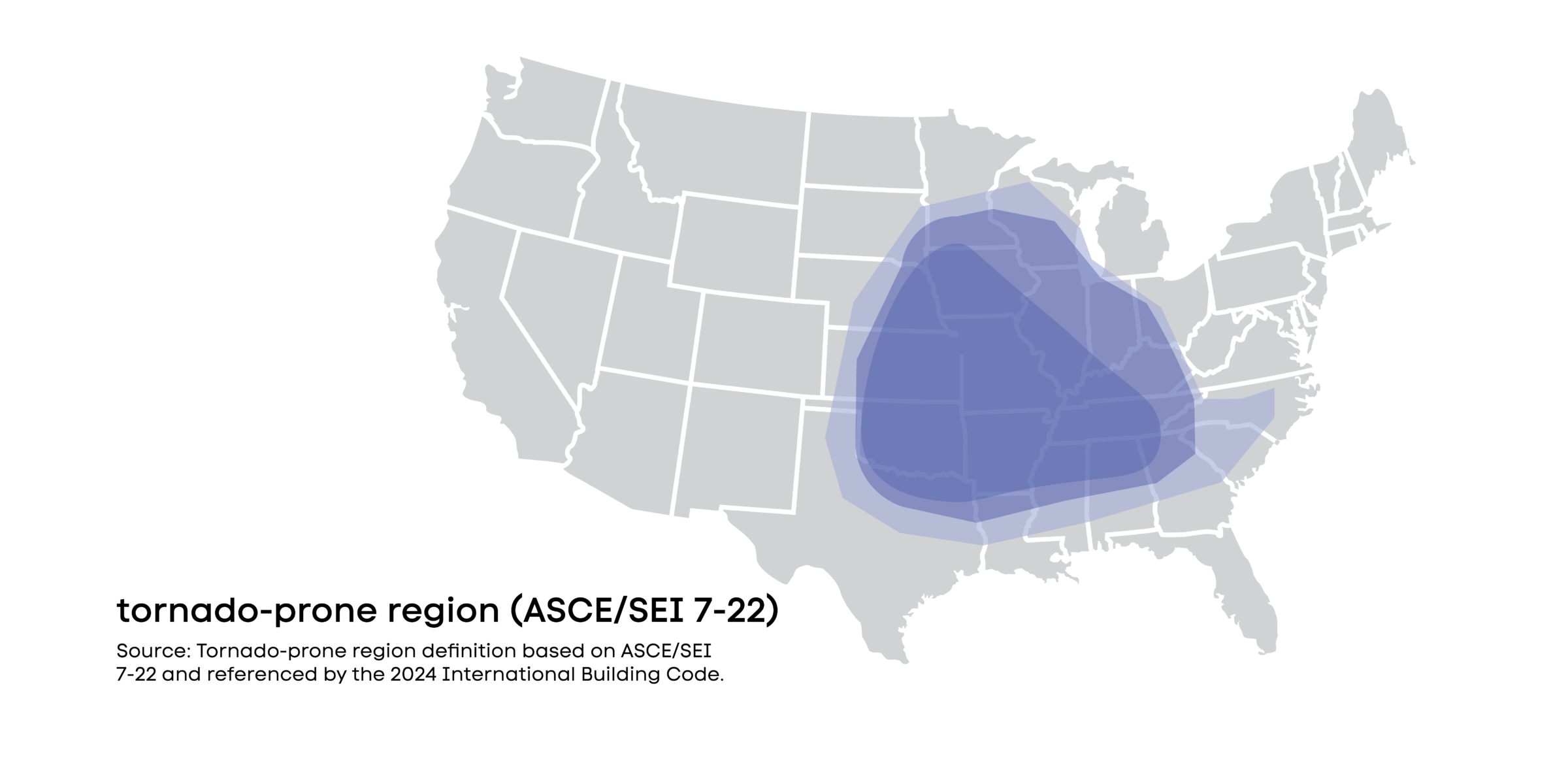
The 2024 International Building Code marks the first time tornado wind loads are formally incorporated into the model building code. Tornado hazard design is now required for Risk Category III and IV buildings located in the designated tornado-prone region, defined in American Society of Civil Engineers ASCE/SEI 7-22 and referenced by the 2024 International Building Code (IBC) as the area of the United States roughly east of the Continental Divide.2
What Changed – And Why It Matters
Tornado wind load criteria in the 2024 IBC represent a structural shift that acknowledges what long-term hazard data have shown for years: tornadoes and severe convective storms account for a disproportionate share of fatalities and insured catastrophe losses nationwide.3
Because the tornado-prone region defined in ASCE 7 lies primarily east of the Continental Divide, these provisions have limited impact on most projects in western states such as California, where seismic hazards govern structural design.2 The code changes are most consequential for healthcare facilities across the Midwest, Southeast and portions of the central United States.4
Another significant change involves risk classification for healthcare facilities.
Under the 2024 IBC, most Group I-2 medical care occupancies, including hospitals and many inpatient healthcare facilities, are now classified as Risk Category IV essential facilities.5 Previously, only facilities providing emergency surgery or emergency treatment automatically qualified as Risk Category IV, leaving many hospitals, nursing homes and similar 24-hour care facilities serving patients incapable of self-preservation in Risk Category II or III.5 That gap is now closed.
For healthcare owners, this is not simply a structural engineering update. It is a governance and risk-management question. Essential facilities are expected to remain operational during and after severe events. The 2024 IBC moves tornado resilience from a voluntary best practice to a codified expectation in many jurisdictions – influencing long-term capital planning and resilience strategies.6
Cost: A Real but Proportionate Impact
Under ASCE/SEI 7-22, tornado design speeds for Risk Category III and IV structures are calibrated to approximately EF0 through EF2 tornado events – the range that accounts for roughly 97 percent of observed tornadoes.2,7 The intent is not to make buildings tornado-proof against worst-case EF4 or EF5 events, but to improve resilience against the tornadoes most likely to occur over a facility’s lifespan.2,7
Early technical commentary and project experience indicate that structural cost premiums associated with tornado load design are typically modest relative to total project cost and highly dependent on building configuration, structural system and local hazard intensity.8 These impacts are best addressed during programming and schematic design, before the pro-forma is fixed and redesign becomes disruptive.8
For owners, the key takeaway is timing. The incremental cost impact of tornado design is typically manageable when incorporated early in project development and far more disruptive if introduced late.6 The earlier resilience expectations are clarified, the more predictable the financial outcome.6
Where It Applies Now: A State-by-State Reality Check
Whether the new tornado provisions apply to a healthcare project today depends largely on jurisdiction. The typical lag between a new IBC edition and state adoption is up to ten years.9 As a result, many healthcare projects permitted today are still operating under older code cycles, even in tornado-exposed regions.9
Broadly speaking, the country currently falls into three adoption categories.
Category 1: 2024 IBC in Effect or Formally Adopted at the State Level
Statewide adoption of the 2024 IBC remains limited. As of early 2026, only a small number of states have clearly placed the 2024 edition into effect statewide, including Georgia (effective January 1, 2026) and Wyoming.10,11
Several additional states have taken formal statewide action adopting 2024-cycle codes or state-amended equivalents, though implementation structures vary.
- Iowa has incorporated the 2024 IBC into its State Building Code framework.12
- New York has updated its Uniform Code based primarily on the 2024 ICC family of codes.13
- North Dakota adopted the 2024 ICC model codes as part of the North Dakota State Building Code, with the updated code taking effect January 1, 2026.14
- Oregon has adopted a Structural Specialty Code based on the 2024 IBC with phased implementation through 2026.15
Other states require more precision.
- Illinois operates under a statewide baseline framework tied to ICC model codes but does not uniformly mandate the 2024 IBC across all jurisdictions.9
- Mississippi has adopted the 2024 IBC within certain state regulatory programs, while broader enforcement continues to depend on local adoption.16
- Florida, which operates under its own state building code based on the IBC and ASCE 7, incorporated tornado-related design requirements for Risk Category III and IV structures in its 8th Edition (2023).17
Uniform statewide enforcement of the 2024 IBC remains the exception rather than the norm.9 At the same time, adoption is advancing locally in major metropolitan markets. Nashville and Knoxville, Denver and select jurisdictions in Iowa, Mississippi and Oregon have moved to 2024-cycle codes ahead of surrounding areas.9,13,15,16
Practical implication: Do not assume the code edition governing your project matches the statewide framework. Major metropolitan jurisdictions often adopt newer codes earlier than surrounding areas. Confirm requirements with the authority having jurisdiction before structural design begins.9
Category 2: On 2021 IBC – A Measurable Path to 2024
A larger group of states has adopted the 2021 IBC or state-amended versions of the 2021 I-Codes statewide and generally follows a structured update process. This group includes Alabama, Arkansas, Louisiana, Maryland, Michigan, Minnesota, Montana, New Jersey, New Mexico, North Carolina, Ohio, Pennsylvania, South Carolina, South Dakota, Utah, Virginia, Washington and Wisconsin, among others.18 In these states, 2024-cycle adoption is not immediate, but it is foreseeable. Healthcare facilities with long programming horizons or phased expansion plans are likely to encounter 2024-based requirements during future additions or major renovations.18
For these markets, the tornado design conversation is less about immediate compliance and more about timing. Owners planning multi-phase healthcare campuses may choose to align performance expectations early in order to avoid inconsistencies between facilities built under different code cycles.6
Beyond this group, however, the national code landscape becomes far less predictable. In several states, code adoption occurs locally, statewide codes lag multiple cycles behind the current IBC or enforcement structures vary significantly from jurisdiction to jurisdiction.9,19
Category 3: Fragmented, Lagging or No Predictable Timeline
States With Local Code Adoption
Some states rely heavily on local code adoption rather than maintaining a single statewide building code. Examples include Missouri, Kansas, Arizona, Nevada and West Virginia, where municipalities or counties determine which IBC edition applies.19 Colorado also operates under a strong home-rule structure, meaning building codes are adopted and enforced primarily at the municipal level.19 In these states, code requirements may vary significantly from one jurisdiction to another.19
States Operating Several Code Cycles Behind
Other states maintain a statewide code framework but remain several cycles behind the most recent IBC.
For example,
- Oklahoma currently adopts the 2018 IBC as its statewide minimum code.20
- Indiana operates under a statewide code derived from the 2012 IBC with amendments.21
- Nebraska maintains a statewide framework based on the 2018 IBC, implemented primarily through local adoption.20
States With Hybrid Adoption Structures
A third group maintains a statewide framework but allows significant local modification.
- Texas requires municipalities to adopt at least the 2012 IBC, though many cities adopt newer editions locally.²²
- Tennessee uses a statewide standard based on the 2021 IBC, while cities such as Nashville and Knoxville have moved to 2024-cycle codes.18
- Kentucky maintains a statewide building code derived from earlier IBC editions with state amendments.19
Minimum code may not reflect regional risk. The strategic decision becomes less about compliance and more about defining your organization’s acceptable performance threshold for essential facilities.⁶
Freestanding EDs and Helipads: Portfolio Implications
Freestanding emergency departments are frequently classified as Group B occupancies when patients are discharged or transferred within 24 hours, meaning they are not automatically treated as Risk Category IV – even under the 2024 IBC.23 For multi-state portfolios, ownership groups may consider establishing internal performance standards that exceed minimum occupancy classifications where continuity of operations is critical.24 The same logic applies to helipad structures. Where heliport infrastructure is integral to emergency operations, applying essential facility-level design criteria may be appropriate even if not explicitly mandated.24
Portfolio-wide consistency is often where this conversation becomes most consequential.6
The Bottom Line for Healthcare Owners
The 2024 IBC’s tornado provisions are targeted, risk-informed and calibrated to the tornadoes most likely to occur – not extreme outliers, but realistic, frequent events.2,7,25 Whether the 2024 tornado provisions apply to your next project depends on jurisdiction. Whether they should influence your next project is a strategic decision.6
Healthcare facilities are long-life assets. The buildings permitted this year are likely to serve communities for 40 to 60 years.26 Code minimums represent a regulatory baseline – not necessarily a resilience strategy. Owners who evaluate both compliance requirements and long-term performance goals early in design retain the most flexibility, the most cost control and the clearest alignment between mission and infrastructure.26
We’re having this conversation with healthcare owners across the region right now
Connect with one of our healthcare leaders today.
References
- National Institute of Building Sciences. (2023). Natural Hazard Mitigation Saves: 2023 Interim Report.
- American Society of Civil Engineers. (2022). Minimum Design Loads and Associated Criteria for Buildings and Other Structures (ASCE/SEI 7-22), Chapter 32: Tornado Loads.
- National Institute of Building Sciences. (2023). Natural Hazard Mitigation Saves: 2023 Interim Report (loss trends from severe convective storms).
- Federal Emergency Management Agency. (2023). National Risk Index – Tornado risk by region.
- International Code Council. (2024). International Building Code (2024 IBC), Table 1604.5 Risk Category of Buildings and Other Structures, and Section 1604.
- International Code Council. (2025). Tornado Load Provisions of ASCE 7-22 (Building Safety Journal technical article).
- ASCE/SEI 7-22 Commentary, Chapter 32: Tornado Loads – discussion of EF0–EF2 calibration and return periods for Risk Category III and IV.
- ASCE/SEI 7-22 Commentary and related engineering interpretation on economic impacts of tornado load provisions.
- International Code Council. (2025). State and Local Adoption of I-Codes: 2025 Update (code adoption lag and patterns).
- Georgia Department of Community Affairs. (2025). New Mandatory State Codes and Georgia Amendments – adoption of 2024 IBC effective January 1, 2026.
- Wyoming State Fire Marshal. (2025). Adoption of 2024 IBC and Related Codes.
- Iowa Administrative Code, Chapter 301 – Adoption of 2024 IBC into the State Building Code.
- New York Department of State. (2025). Uniform Code Update Based on 2024 ICC Codes.
- North Dakota Department of Commerce. (2025). North Dakota State Building Code – Community Services (adoption of 2024 ICC model codes, effective January 1, 2026).
- Oregon Building Codes Division. (2025). 2025 Oregon Structural Specialty Code based on the 2024 IBC, phased adoption.
- Mississippi Office of the State Fire Marshal. (2025). Adoption of 2024 IBC/IFC in State Regulatory Programs.
- Florida Building Commission. (2023). Florida Building Code, Building (8th ed.) – provisions referencing ASCE 7-22 tornado loads for higher risk categories.
- International Code Council. (2025). State and Local Adoption of I-Codes: 2025 Update – states on 2021 IBC and structured update cycles.
- National Institute of Building Sciences. (2023). Building Codes and Standards Overview – local adoption and hybrid frameworks; ICC I-Code usage.
- Oklahoma Uniform Building Code Commission. (2024). Adoption of 2018 International Building Code as Statewide Minimum.
- Indiana Department of Homeland Security. (2024). Currently Adopted Building Codes – state code derived from 2012 IBC.
- Texas Department of Licensing and Regulation. (2024). Mandatory Building Codes for Industrialized Housing and Buildings – minimum 2012 IBC requirement with local options.
- International Code Council. (2024). International Building Code (2024 IBC), occupancy definitions for Group B and Group I-2, Table 1604.5.
- Federal Aviation Administration. (2022). Advisory Circular 150/5390-2D: Heliport Design – role of heliports in emergency operations.
- ASCE/SEI 7-22 Commentary, Chapter 32; International Code Council. (2024). International Building Code (2024 IBC) tornado load provisions.
- American Society for Health Care Engineering. (2023). Healthcare Facility Life-Cycle Planning – typical 40–60 year service life and resilience planning guidance.